Sunday, 23 September 2012

Mediated Identity and Interaction

The introduction of telephones and especially the internet as a communication medium has dramatically changed the way we communicate. The telephone has allowed spontaneous communication with people who you are not physically located with, however it is essentially a voice medium and as such limits communication as it removes nonverbal forms of communication (as does written communication) and leads to a potential communication breakdown.

The internet went one step further by adding written communication into this technological advancement, in the form of e-mails, blogs ect. However in doing so it added the same potential limitation as any written communication.

When communication online often there is no way to know when someone receives your communication. This is known as disembeded communication. However recent technological advances are attempting to re-embed communication. The creation of mobile phones capable of accessing the internet wirelessely means that communication over the internet is now much more accessible and thus we generally expect a reply quicker.
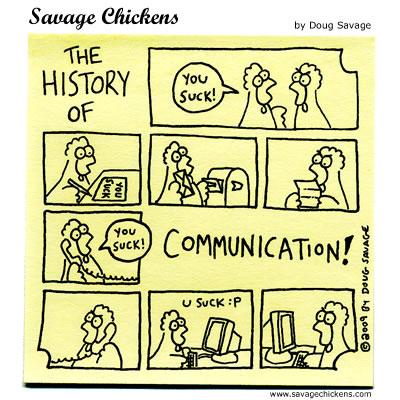


Online communication though does have its advantages. For one it leaves a record of communication. This can be useful for recalling the exact wording of a conversation or tracing someones knowledge of the message being communicated. It is also to a degree anonymous. It is hard for the general person accessing the internet to know exactly who said what unless you know who the person you are communicating with is but if you do enough research then it is possible to gather some information on the person. This idea of anonymity leads to varying behaviours online ranging from polite and helpful to downright abusive and some people feel comfortable doing things online they they would not do in person as they feel they will not be traced.  Online communication is also a good method of one way communication such as news articles and the lecture recordings.


Tales of Symphonia Quote: Rodyle: [On Hologram Projector, after Magnius intends to contact Forcystus and tell him he was deceived about the Chosen] "I have a slight problem with you contacting Lord Forcystus. He'd realize what I'm trying to do."

Thursday, 13 September 2012

Accomplishing Socio-cultural Identity in Talk


Have you ever been listening in on a conversation and realised that although the participants are clearly speaking English that you don't understand what they are saying. You can hear them fine the issue is the way they are speaking. They are using slang words, and phrases and communicating in a way that is different from what you expect. They are communicating in a specific way that is showing their specific cultural or socio-cultural identity.

In 1972 Garfinkel stated that“To recognize what is said means to recognize how a person is speaking”. This shows that people have specific ways of speaking and that the way they speak shows their specific socio-cultural identity and that this is observed by recognising the meaning of what a person is saying not just the words they actually use.

An article in the Journal of Discourse Studies proposes that identities have five major factors:
1) Identity is the product rather than the source of linguistic and other semiotic practices.
2) Identities encompass macro-level demographic categories.
3) Identities may be linguistically indexed through labels, implicatures, stances, styles, or linguistic structures and systems.
4) Identities are relationally constructed through several, often overlapping, aspects of the relationship between self and other
5) Identity may be in part intentional, in part habitual and less than fully conscious

The above framework shows the basic elements of communication and how they are formed by and used to show a person's specific cultural identity. Below is an example of Gamer identity although it borrows aspects of identity from internet meme identity. The use of specific language in a specific way creates an identity for the person who created the graphic but it is best interpreted by those that share the same cultural interests and thus understand the identity being portrayed.


Tales of Symphonia Quote: "Dwarven Vow #1: Let's all work together for the sake of a peaceful world." This shows Lloyd's affiliation and familiarity with the dwarven culture through the use of the language that he is using (eg. Quoting the dwarven vows).


References:


Bucholtz, M. &. Hall, K.  (2005). Identity and interaction: a. Discourse Studies , pp. 585-614.

Sacks, Harvey. "An Initial Investigation of the Usability of Conversational Data for Doing Sociology." In Studies in Social Interaction, edited by David Sudnow, 31-63. New York: Free Press, 1972.

Group Presentation on The Social and Moral Order of Talk


Reference for Video:

Cendrowski, M. (Director). (2008). The Big Bang Theory Season 1 Episode 10 "The Loobenfeld Decay" [Motion Picture].


Friday, 7 September 2012

The social and moral order in talk


Imagine you are the man in the above scenario. You drive yourself nuts thinking about it and trying to understand what her running out without giving a response means....Now consider that you run into her the next day and she acts like nothing has happened. You don't know what she is thinking or why she is acting this way. You try to justify her behaviour but you just can't comprehend it and don't understand what is happening.

The above scenario is a situation in which the code has been broken. When you propose to someone you (generally) hope for a positive response but are aware the response may be negative but you do expect a response. The code states that when someone asks you a question the polite thing to do is to answer them. Especially if the person asking is someone you are close to and the question is one of importance. When you don't provide a response the code has been broken.

When a code is broken we instinctively try and justify why it was broken and why the person acted or responded the way they did. That is why you would wonder what your partner was thinking when she ran out on you without giving an answer when you proposed and why you cant comprehend her acting like nothing happened the next day. This response does not fit the rules of the code as you understand them and thus you try to explain away the behaviour but in such a complex scenario that is not always easy to do. In a sense the ability to understand and act within the social code of  a particular situation is the ability to have the appropriate social skills for the situation. Perina states that understanding and obeying the code is not a matter of ettique so much as it is a matter of how one handles social situations (Perina, 2004).


Tales of Syphonia Quote: 
Sheena: "I am Sheena! I seek a pact with Gnome. I ask that thou annulst thy pact with Mithos, and establish a new pact with me."
Gnome: "Man, you sure use some stuffy language. Bleh."
Sheena: "Uh.Well...I mean. This is how I was taught to do it." 


References:

Perina, K. (2004). Hacking the Social Code. Psychology today, p.3.