Tales of Symphonia Quote: Mithos Yggdrasill: "Farewell, my shadow, you who stand at the end of the path I chose not to follow. I wanted my own world, so I don't regret my choice. I would make the same choice all over again. I will continue to choose this path!"
Saturday, 27 October 2012

Independent Research Project
Analysis of Comments on IGN Article Titled "Why
Real-World Morals Have No Place in Video Games”
IGN is a website dedicated to news, review and information
on an assorted range of video game consoles. Over the years this website has
been in existence this range has grown to include movies, television shows and
mobile phone apps as well as articles relevant to the industry (Internet Gaming Network, 2012) . One such article
published by IGN at the URL of http://au.ign.com/articles/2012/08/20/why-real-world-morals-have-no-place-in-video-games
on the 19th of August 2012 was titled “Why Real-World Morals Have No Place in
Video Games” (Biggs, 2012) . Like most articles
published by IGN this article had a comments section at the bottom of the page
for people who have signed up as members of the site to make comments on the
content of the article. As of the 27th of October 2012 there are 505
comments that have been made on the article however for the purpose of
analysing the discussion that takes place on IGN articles only a small number
of these comments will be analysed. The section for analysis has been copied by
Nicholas Blaxell and reposted on http://thoughtsoneverydayinteraction.blogspot.com.au/2012/10/data-presentation.html
(Blaxell, 2012) on the 3rd of
October 2012.
The section of comments chosen for analyses consisted of the
earliest posted comments. This consisted of the earliest nine posted comments
and the replies that they had received by the 3rd of October 2012.
This section of the comments was chosen regardless of the ranking or relevance
of the comments as it follows a historic pattern of post and reply much like a
spoken conversation and thus provides a relevant and hopefully accurate record
of how the conversation between the commenters on this article progressed.
This data was chosen as by analysing the data source and the
interaction taking place in the comments section of this article a person would
learn numerous things including about people who use the IGN comments section, about
people who have an interest discussing the morals of video games. Also to learn
more about the interaction that takes place on comment sections of articles
posted by IGN, to learn about the methods, style and patterns of communication
used to communicate between the members of the IGN community and to learn about
the language, content and flow of discussions, including the continuity of the
discussion and random changes of topic that occur on IGN the IGN comment
sections of their articles.
A common misconception of online communication is that of anonymity.
Anonymity must be contrasted with identity. Sometimes when people interact
online, such as in forums and comments threads such as those used by IGN there
is a belief that no-one really knows who a person is as they are identified by
a screen name and the people they interact with do not actually know them in
person. However this is a misconception as not only can websites and Internet
Service Providers (ISP’s) identify the computer being used to communicate with
the website - as can government agencies - there is also the ability for people
to put common links together to identify someone. Many of these screen names
have profiles which can be used to identify some personal information. This is
also the case with IGN although the people whose comments are being analysed in
this data set had not placed any personal information on their IGN’s forum
profiles beyond age and the state in which they reside. This makes it difficult
for the casual observer to identify them however if the user uses the same
screen name numerous sites then it may still be possible for the average person
to piece together information from other sites to identify them.
Online communications, such as the IGN comments thread on
this article have their limitations though as the people reading the
conversation taking place are forced to interpret the message from the written
words alone. This makes it difficult for people with poor written
communications skills to communicate via the comments thread on IGN’s articles (Crispin, 2008) . Where there is no
body language or other non-verbal signals to clarify the message greater
diversity in how a person chooses to interpret a message may lead to
misinterpretation as for example a comment that is intended to be sarcastic may
in fact be interpreted as genuine and thus miscommunication will occur
(Kendall, 2002, p. 167). However in order to assist in clarifying emotional
inferences in text based communication emoticons and the use of capital letters
have become a popular way of assisting in this clarification and emphasising
emotional responses like humour. This is shown by ‘zonda777’ usage of all
capital letters when commenting “THERE IS NO ESCAPE” in an attempt to add
emphasis to their comment.
Comment forums such as this also have the limitation that
you don’t know who is or will be reading your comment thus you cannot target
your message towards a specific audience and that if you do target a message
towards a specific person you have no way of knowing when or if they have
received the message and replied (b00036796, 2011) . This is shown
frequently in the data source when a person replies to or comments upon a
previous post by agreeing or disagreeing with what is being said but they do so
in a general way that shows that they do not expect the person to whom they are
replying to actually receive and acknowledge their comment. This refers to the
response presence or the lack thereof that is a part on online communication
methods like IGN’s comments threads on article. Due to this the conversation
often time deviates out to many singular comments and although later posters
may refer or respond to a comment there is little ongoing communication between
the participants in the conversation. This
results in minimal formation of relationships although alliances can be seen
where different screen names argue the same points of view or agree on similar
ideas as in seen by the in the first comment by ‘DarkPsycho_PS3truthh’ and the
responding commenters.
Linguistic metadiscussion refers to language and specific
terms that have a specific meaning and are thus used in a specific context.
Linguistic metadiscussion is interesting in its usage in the comments on this
article. Linguistic metadiscussion seems to be commonplace in computer-mediated
chat situations. Interestingly enough linguistic
metadiscussion was barely utilised in the chosen section of the comments of
this article. However I do see a link to socio-cultural talk. Socio-cultural
talk is similar to linguistic metadiscussion as it refers to words and terms
that are either specific or have a specific meaning to a social or cultural
group. This includes the usage of linguistic metadiscussion terms such as
abbreviations and more general ways of speaking which are commonly used amongst
those with similar interests and thus identify a socio-cultural group ( Beacco,
Coste, & Piet-Hein, 2010, p. 14) . The cultural group
that IGN targets is that of computer gamers, who have access to an internet connection
and can read English. In respect to the specific comments being analysed ‘Officerpup19plus3i’
uses sociocultural talk through the use of the word trolls (which in this case
refers to people who stalk online communication forums and make negative
comments about other participants or comments designed to upset, annoy or
insult people who may frequent that forum, not trolls, the species that exists
in in the traditional fantasy sense) and ‘MasZiv3DynamiC’ usage of the word
fail. In this context the word fail still has its native meaning but has become
such a commonly used term by those who frequent online communication that it could
be seen as blurring the lines between sociological talk and linguistic metadiscussion.
One of the great debates surrounding online communication is
that of public vs. private communication. Unlike spoken communication, online
communication leaves a record of all activity that is communicated. This record
allows the communication between people to be viewed long after it has taken
place and as the communication can be copied and stored elsewhere even if the
original post were deleted, as is assumed to be the case with ‘lllFreqEteQlll’ comment
saying “Oops, double post”, an copy of the original communication may still
exist and thus a permanent record of the communication can be created and
utilised at a later date in a way that could have positive and negative
consequences. Some websites have privacy restrictions allowing only certain
people certain levels of access in an attempt to protect information. As does
IGN in regards to their members signing up for profiles so that they can make
comments on articles (Internet Gaming Network, 2011) . However the comments
on this article are in the public forum. This leads to questions that must be
considered when analysing the comments made by the individual posters on this
article. Did the person who made a comment realise anyone could read it and if
they did then did they make a comment assuming a specific audience would be
unlikely to read it and would they not have made the comment if they knew a
particular person would read their comment? These questions can be asked in
regards to ‘THEHORGANATOR’ and their comment “I came here to jerk off! :D”.
This is a comment made where the assumption can be made that the comment was
made due to their belief in their own anonymity and that they would not have
made the comment if they were aware that people such as family members would
view this comment. This of course is an assumption based upon expectations of
behaviour however ‘THEHORNAGATOR’ may feel comfortable making comments like
that fully aware that the comment is a public comment and that people who know
them may read the comment and identify them as being the one who made it and
the social implications of this comment. There is also an issue of the
ownership of a comment. Are the comments being analysed the property of the person
who typed them or are they the property of IGN, as this was the site on which
they were posted? Who holds copyright right rights to these comments? This is
an area that is still under debate in many countries and due to the nature of the internet not having any national boundaries these
questions are yet to have a definitive answer (Future of Privacy, 2012) .
The comment made by ‘THEHORGANATOR’ is also an example of
how the conversation deviates away from the focus of the article. However it
can be noted that this deviation only occurs for 3 or 4 member’s replies before
someone posts a comment to bring the conversation back to its focus. A
potential reason for this could be that people post comments based upon the
article and not upon the current conversation or it could be an intentional
effort to restore the focus of the conversation.
This link’s into Erving Goffman’s theory of facework. Facework
in relation to the data example is limited due to the anonymity of the
participants and the fact that it is likely that there will be a delay between
someone commenting and a response and that due to this delay they may not
recheck the discussion thread to see the responses however the basic principles
still apply. The basic principle of facework is that through evaluating one’s
self and other individuals in a particular group setting, one engages in actions
that are indicative of one’s particular point of view, these actions are then
judged by others based upon social norms, expectations and stigmas. (Unknown_Aurthor, 2010) There is a desire to
present a positive face (a positive social standing) and not a negative face,
to save face (earn back a positive social standing after an experience that is
upsetting or embarrassing or otherwise creates a negative social appearance)
not lose face.
Goffman also developed a theory of dramaturgy that proposed
both front and back stage communication. Traditionally Front stage
communication is the actions that are observable by others while backstage communication
are those that are conducted in private. However there can be more than two
stages where stages develop between the front most and backmost stages where certain
actions are observable by specific people but not by others (Kivisto & Pittman, 2007, p. 280) . However in online
communication the idea of stages can be twisted so that it not only applies to
the observed communication but to the content. It is possible to view the
comments in this data source by this method and consider the idea of comments
such as ‘pieman2800’ comment to be considered as a front stage comment as it is
relevant to the topic of the article while the comment made by ‘Salnax’,
although relevant to the conversation as it is responding to the comment made
by ‘Sinn_Exit’ is on a slighter further back stage as it is not relevant to the
article. In a sense this relates to scopic systems as a scopic system is one
that focuses on a specific idea. So the most front stage comments are the one
the scopic system focuses on.
Another theory of communication that branches from Goffman’s
theories is that of interacting with objects and systems ( Karray, Alemzade, & Jamil, 2008, p. 2) . This theory shows
that communication can be both back and front staged at the same time, when it
relates to online communication. Put simply the people commenting on this
article communicated backstage with their computers, or similar devices, and
the internet and connected networks needed to upload their comment onto the
webpage of the article when posting their comments, while they were
communicating via front stage with those people who were utilising these
resources to read and potentially respond to their comments.
Online interaction also has a unique aspect to add to facework
where not just the comments received in reply but the ability to vote up or
down a comment shows what people think of a comment. Negative votes can be seen
as a loss of face and positive comments can be seen as a positive face being
acquired or even others attempting in saving face for the original commenter.
This is seen in regards to the up votes on ‘lllFreqEteQlll’ comment “Oops,
double post.” and the comment made in regards to it by ‘Johnny_721’ saying “Wow,
no down votes on a double post. People here must like you” as an attempt to
save face for ‘lllFreqEteQlll’.
Due to the nature of the comments thread on this article and
the fact that IGN only highlights the article for a short period of time
(generally a couple of days) before it get archived in the history of the site
the communication occurring has specific limitations. As previously stated this
limits the frequency that people return and thus tends to prevent relationships
building and ongoing communication developing and instead often results in a
series of single person comments (as is found in a formal debate) creating a conversation.
Also as stated often times the conversation deviates away from the focus of the
article, as does an informal conversation, and although this new conversation
thread gets responses they tend to only last for 3 or 4 comments before someone
comments in a way that brings the conversation back on to the focus of the
original topic “Why Real-World Morals Have No Place in Video Games” This shows
that in this case the communication in the data source has similarities to both
common informal communication and formal preplanned conversation and focuses heavily
on the theories of computer mediated communication, which is only natural with
the data source being an example of online communication and Erving Goffman’s
theories of communication.
Beacco, J.-C.,
Coste, D., & Piet-Hein, v. d. (2010). Language and school subjects.
Strasbourg: Council of Europe.
Karray, F.,
Alemzade, M. h., & Jamil, S. A. (2008). INTERNATIONAL JOURNAL ON SMART
SENSING AND INTELLIGENT SYSTEMS. Human-Computer Interaction: Overview on
State of the Art, 2.
b00036796. (2011,
October 31). Advantages and Disadvantages of Online Forums. Retrieved
October 27, 2012, from Edublogs:
http://edu307fall2011.edublogs.org/2011/10/31/advantages-and-disadvantages-of-online-forums-2/
Biggs, T. (2012,
August 19). Why Real-World Morals Have No Place in Video Games.
Retrieved October 27, 2012, from WWW.IGN.com.au:
http://au.ign.com/articles/2012/08/20/why-real-world-morals-have-no-place-in-video-games
Blaxell, N. (2012,
October 3). SOC250 Data Presentation. Retrieved October 27, 2012, from
Blogspot:
http://thoughtsoneverydayinteraction.blogspot.com.au/2012/10/data-presentation.html
Crispin, B. (2008,
November 2). Bang The Table. Retrieved October 27, 2012, from Advantages
& disadvantages of online communication:
http://bangthetable.com/2008/11/02/advantages-disadvantages-of-online-communication/
Future of Privacy.
(2012, October 27). Online. Retrieved October 27, 2012, from Future of
Privacy: http://www.futureofprivacy.org/issues/online/
Internet Gaming
Network. (2011, May 31). Privacy Policy. Retrieved October 27, 2012,
from IGN: http://corp.ign.com/privacy.html
Internet Gaming
Network. (2012, October 27). We're IGN Entertainment, a leading online
media & services company obsessed with gaming, entertainment and
everything guys enjoy. Retrieved October 27, 2012, from IGN:
http://corp.ign.com/about/
Kendall, L.
(2002). Hanging out in the Virtual Pub: Masculinities and. Berkeley,
CA: University of California Press.
Kivisto, P., &
Pittman, D. (2007). Goffman's Dramaturgical Sociology. Sage Publishing.
Unknown_Aurthor.
(2010, December 9). Goffman, Erving. 1955. "On-Face Work"
(338-343). Retrieved October 2012, 27, from DJJR Sociology:
http://mills-soc116.wikidot.com/notes:goffman-face-work
Thursday, 4 October 2012
Expletives, Epithets, Profanity and ‘Rudeness’

The study of language is an interesting one as words themselves have no meaning. The meaning given to a word is based upon our interpretation of the word based up both its context and the prior learning knowledge and relationships that we have learned to associate with the word (Austin 1962).
However anyone with a basic understanding of a language has come to associate certain words with certain meanings. Due to this there are many words that are considered offensive or impolite. That said it is also important to notice how a word is used. Some words are much more offensive to some people or in certain social groups or conditions then others. (refer Appendix 1.)
Due to this there are some words that are considered rude or offensive in some aspects that are either acceptable within certain socio-cultural groups or in ways in which a word is used in an entirely different way, without its normal meaning or even to show a relationship between people. Such as in the case of some young males where they insult each other in a friendly manner to show the close relationship between them.

It is also important to consider the original meaning of a word as some words that are considered rude may have originally had a very different meaning to the commonly perceived meaning in modern society while other words that are perfectly acceptable can be considered rude when used in a particular context. The word 'Black' is perfectly acceptable when referring to a colour however if it is used when referring to a person then it is generally considered rather offensive in sections of modern society (Paine, 2012).
I recently asked some friends to post their opinions on words, phrases ect that uses swearing, abusive language, rudeness ect and what is the worst thing that they can think of that will not actually offend someone. Or if it might offend someone then to put it in a context where you would use it where it would be acceptable. (refer Appendix 1 and 2)
Tales of Symphonia Quote: Lloyd: [After seeing what the Desians have done] "Damn Desian Bastards!"
http://shirindemirdag.blogspot.com.au/2012/10/freedom-online.html
Appendix

Appendix 2.
A quote on offensive language and rudeness by Gregory Blaxell. "Offensive language is a matter of context and register and the trick in using certain language terms depends on your understanding of these paramaters. In Australia, for example, you can call a person a bastard and this is almost a term of intimacy. If you used the same phrase in the USA there would be stunned silence and instant withdrawal or aggression. Bloody no longer has any negative connotations but should be used sparingly and not as a filler.Then it becomes infinitely boring. There are some terms from the USA that have received some acceptance in Oz. A term like 'motherfucker' I believe to be still totally unacceptable but that is a personal view. which brings up the point about what is 'offensive language. 'Fuck' that often used term can have a multitude of meanings and is often used as a filler. 'Fuck' has evolved from an absolutely taboo word, when I was growing up, to an almost everyday expression. A difficult word is 'cuint'. Again it has acquired many connotational meanings. If it refers to female genitalia, I know it goes back to its original meaning (OE) and I have no complaint. But it's not the word or its original meaning that is offensive but one must be conscious of the context in which it can be used. It is still not a publicly acceptable word, especially for women. Privately, it may be totally appropriate but then it is not offensive and could be loving. However, when the word is used to describe an unpleasant act or an unpleasant person, eg 'you stupid fucking cunt' then it is explosive and very derogatory towards women - the nexus being that a 'cunt' is (according to some sections of society) offensive by its very utterance and the phrase just used takes on that patina of being a stronger version of the unacceptable."
Bibliography:
Austin, J. L. (1962) How to Do Things With Words. Oxford University Press.
Paine, C. (2012,
September 28). The dirty word tweeted 2.5 million times since July.
Retrieved October 05, 2012, from news.com.au:
http://www.news.com.au/technology/the-dirty-word-tweeted-25-million-times-since-july/story-e6frfro0-1226483166589
Wednesday, 3 October 2012
Data Presentation
My data Presentation will be on the communication contained within the following screenshots. They were taken from the comments thread of the article entitled "Why Real-World Morals Have No Place in Video Games" from the url http://au.ign.com/articles/2012/08/20/why-real-world-morals-have-no-place-in-video-games


Sunday, 23 September 2012
Mediated Identity and Interaction
The introduction of telephones and especially the internet as a communication medium has dramatically changed the way we communicate. The telephone has allowed spontaneous communication with people who you are not physically located with, however it is essentially a voice medium and as such limits communication as it removes nonverbal forms of communication (as does written communication) and leads to a potential communication breakdown.
The internet went one step further by adding written communication into this technological advancement, in the form of e-mails, blogs ect. However in doing so it added the same potential limitation as any written communication.
When communication online often there is no way to know when someone receives your communication. This is known as disembeded communication. However recent technological advances are attempting to re-embed communication. The creation of mobile phones capable of accessing the internet wirelessely means that communication over the internet is now much more accessible and thus we generally expect a reply quicker.
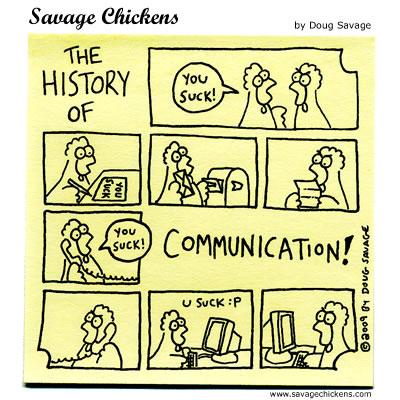
Online communication though does have its advantages. For one it leaves a record of communication. This can be useful for recalling the exact wording of a conversation or tracing someones knowledge of the message being communicated. It is also to a degree anonymous. It is hard for the general person accessing the internet to know exactly who said what unless you know who the person you are communicating with is but if you do enough research then it is possible to gather some information on the person. This idea of anonymity leads to varying behaviours online ranging from polite and helpful to downright abusive and some people feel comfortable doing things online they they would not do in person as they feel they will not be traced. Online communication is also a good method of one way communication such as news articles and the lecture recordings.

The internet went one step further by adding written communication into this technological advancement, in the form of e-mails, blogs ect. However in doing so it added the same potential limitation as any written communication.
When communication online often there is no way to know when someone receives your communication. This is known as disembeded communication. However recent technological advances are attempting to re-embed communication. The creation of mobile phones capable of accessing the internet wirelessely means that communication over the internet is now much more accessible and thus we generally expect a reply quicker.
Online communication though does have its advantages. For one it leaves a record of communication. This can be useful for recalling the exact wording of a conversation or tracing someones knowledge of the message being communicated. It is also to a degree anonymous. It is hard for the general person accessing the internet to know exactly who said what unless you know who the person you are communicating with is but if you do enough research then it is possible to gather some information on the person. This idea of anonymity leads to varying behaviours online ranging from polite and helpful to downright abusive and some people feel comfortable doing things online they they would not do in person as they feel they will not be traced. Online communication is also a good method of one way communication such as news articles and the lecture recordings.
Tales of Symphonia Quote: Rodyle: [On Hologram Projector, after Magnius intends to contact Forcystus and tell him he was deceived about the Chosen] "I have a slight problem with you contacting Lord Forcystus. He'd realize what I'm trying to do."
Thursday, 13 September 2012
Accomplishing Socio-cultural Identity in Talk
Have you ever been listening in on a conversation and realised that although the participants are clearly speaking English that you don't understand what they are saying. You can hear them fine the issue is the way they are speaking. They are using slang words, and phrases and communicating in a way that is different from what you expect. They are communicating in a specific way that is showing their specific cultural or socio-cultural identity.
In 1972 Garfinkel stated that“To recognize what is said means to recognize how a person is speaking”. This shows that people have specific ways of speaking and that the way they speak shows their specific socio-cultural identity and that this is observed by recognising the meaning of what a person is saying not just the words they actually use.
An article in the Journal of Discourse Studies proposes that identities have five major factors:
1) Identity is the product rather than the source of linguistic and other semiotic practices.
2) Identities encompass macro-level demographic categories.
3) Identities may be linguistically indexed through labels, implicatures, stances, styles, or linguistic structures and systems.
4) Identities are relationally constructed through several, often overlapping, aspects of the relationship between self and other
5) Identity may be in part intentional, in part habitual and less than fully conscious
The above framework shows the basic elements of communication and how they are formed by and used to show a person's specific cultural identity. Below is an example of Gamer identity although it borrows aspects of identity from internet meme identity. The use of specific language in a specific way creates an identity for the person who created the graphic but it is best interpreted by those that share the same cultural interests and thus understand the identity being portrayed.

Tales of Symphonia Quote: "Dwarven Vow #1: Let's all work together for the sake of a peaceful world." This shows Lloyd's affiliation and familiarity with the dwarven culture through the use of the language that he is using (eg. Quoting the dwarven vows).
References:
Bucholtz, M.
&. Hall, K. (2005). Identity and
interaction: a. Discourse Studies , pp. 585-614.
Sacks, Harvey. "An Initial Investigation of the Usability of Conversational Data for Doing Sociology." In Studies in Social Interaction, edited by David Sudnow, 31-63. New York: Free Press, 1972.
Group Presentation on The Social and Moral Order of Talk


Reference for Video:
Cendrowski, M.
(Director). (2008). The Big Bang Theory Season 1 Episode 10 "The
Loobenfeld Decay" [Motion Picture].
Friday, 7 September 2012
The social and moral order in talk
Imagine you are the man in the above scenario. You drive yourself nuts thinking about it and trying to understand what her running out without giving a response means....Now consider that you run into her the next day and she acts like nothing has happened. You don't know what she is thinking or why she is acting this way. You try to justify her behaviour but you just can't comprehend it and don't understand what is happening.
The above scenario is a situation in which the code has been broken. When you propose to someone you (generally) hope for a positive response but are aware the response may be negative but you do expect a response. The code states that when someone asks you a question the polite thing to do is to answer them. Especially if the person asking is someone you are close to and the question is one of importance. When you don't provide a response the code has been broken.
When a code is broken we instinctively try and justify why it was broken and why the person acted or responded the way they did. That is why you would wonder what your partner was thinking when she ran out on you without giving an answer when you proposed and why you cant comprehend her acting like nothing happened the next day. This response does not fit the rules of the code as you understand them and thus you try to explain away the behaviour but in such a complex scenario that is not always easy to do. In a sense the ability to understand and act within the social code of a particular situation is the ability to have the appropriate social skills for the situation. Perina states that understanding and obeying the code is not a matter of ettique so much as it is a matter of how one handles social situations (Perina, 2004).
Tales of Syphonia Quote:
Sheena: "I am Sheena! I seek a pact with Gnome. I ask that thou annulst thy pact with Mithos, and establish a new pact with me."
Gnome: "Man, you sure use some stuffy language. Bleh."
Sheena: "Uh.Well...I mean. This is how I was taught to do it."
References:
Perina, K. (2004).
Hacking the Social Code. Psychology today, p.3.
Thursday, 30 August 2012
Ethnomethodology
One of the main principles of ethnomethodology is that sociology and sociologist's should treat social facts as interactional accomplishments.
In 1964 Schutz stated that without a grasp of the intersubjective aspects of social life, sociology
"loses its basic foundations, namely its reference to the social world of everyday life and experience. The safeguarding of the subjective point of view is the only but sufficient guarantee that the world of social
reality will not be replaced by a fictional non-existing world constructed by the scientific observer" . In short that means that "sociological procedures legislate a reality rather than discover one" (Smith, Dorothy p.53. 1990).
The basic idea of everything being relative is the foundation of a lot of meme's as one of the common themes is "you're doing it wrong". however utilising the principles of ethnomethodology there is no wrong way to do something simply the way that particular person has chosen to complete this particular act.

The article "Ethnomethodology" published on Psychlopedia, gives a good explanation of ethnomethodology, its philosophical underpinnings, techniques and applications. It also critiques the theory and states that "Sometimes, ethnomethodology is regarded as a form of relativism, because no objective patterns or regularities are assumed. As a form of relativism, ethnomethodology cannot address moral issues such as inequality and power." (http://www.psych-it.com.au/Psychlopedia/article.asp?id=213)
Tales of Symphonia quote by Lloyd: "Regardless of who your real father is, you’re still you. Nothing’s changed. You just have two fathers. Just think of yourself as being lucky for having more than most people do." This quote shows how Lloyd is looking at Collete's situation from a relative point of view and not judging against preconceived rules of society. In short Lloyd is applying the rules of ethnomethodology.
Commented: http://www.natlombardo250.blogspot.com.au/2012/08/me-me-me-presentation-of-self-this.html
References:
Thursday, 23 August 2012
Life as a Drama
Have you ever though about why you perform certain actions in private as opposed to those you do in public. This is one of the main aspects of "Dramaturgy". Although the idea was formally presented by Goffman he had numerous inspirations for conceiving this idea. Some of his inspirations link back as far as William Shakespeare. One of Shakespeare's more famous quotes that related to the theory of dramaturgy is
Comment: http://sociologyandstuff.blogspot.com.au/2012/08/goffman-and-andy-do-you-think-babies.html
“All the world’s a stage,
And all the men and women merely players;
They have their exits and their entrances;
And one man in his time plays many parts,
His acts being seven ages …”
The basic idea of dramaturgy is that life is a game or a drama and that like any game it has rules which the players are expected to follow. These rules lead to an ideal where social interaction in our world is conducted on stages, just like a play. There is the interaction that happens on the front stage and is open for the audience to see and then there is the interaction that happens back stage which is viewable only to a select few. In some instances further 'behind the scenes stages' exist to create more then 2 stages for interaction.
An example of backstage work is the effort you go to planning for a job interview and organising what to wear and what questions you wish answers to, while the front stage work is actually attending the job interview, wearing the clothes and the questions you ask in the interview.
Although a mock of the differences between males and females the following meme shows the backstage process of getting ready with the final pannels showing the front stage results.

An example of backstage work is the effort you go to planning for a job interview and organising what to wear and what questions you wish answers to, while the front stage work is actually attending the job interview, wearing the clothes and the questions you ask in the interview.
Although a mock of the differences between males and females the following meme shows the backstage process of getting ready with the final pannels showing the front stage results.
The rules that control what interaction happens on what stage are controlled but the ritual structure of society. For example it is seen as inappropriate to interact intimately with a partner in public yet that behaviour is perfectly acceptable in private. By following these unwritten rules we know what behaviour is appropriate in certain situations.
Tales of Symphonia quote: [After he hugs Lloyd from behind after preparing a meal with sleeping drugs in it] "Cause we're best friends, right? I worry about you. You must be tired" This quote shows the difference between front stage (observable) and backstage (hidden) behaviour.
Comment: http://sociologyandstuff.blogspot.com.au/2012/08/goffman-and-andy-do-you-think-babies.html
Friday, 17 August 2012
What is 'The self'
Personally I found Goffman's ideas on the presentation of self to be rather unusual. It is at times very interesting and at times very difficult to stay interested it.
The lecture material was on Erving Goffman (http://people.brandeis.edu/~teuber/goffmanbio.html). Although one of Goffman's works is titled "the Presentation of Self in Everyday Life", I personally found that the lecture focused more on Goffman's style of research and writing and consisted of a brief overview of some of his jobs and how he carried out his research more then it focused on the actual topic of presentation of self.
In my opinion Goffman's research styles and methods go directly against what we are being taught today at modern universities. He had no method (or at least didn't publish a method). This is the exact opposite to what students the world over are being taught about how to conduct research. They are being taught to control, record, obey and publish all aspects of their methodology for any research activity and yet Goffman got away without following the same restrictions. That said some of his research methods would not pass ethical standard in today's society.

This concept of a single person playing differing social roles in different social situations is an ever increasing concept with the modern trend of social networking sites and other modern technologies. This allows others to see how we interact when we are not with them and provides a more general view of ourselves. This said what we post on these social networking sites and how we act is still a particular social role we choose to display. It is just a social role that is more viable to differing sections of society and thus either incorporates aspects of many different roles or allows people to see us in a role that we would not normally display to them.
Tales of Symphonia Quote: "[Sheena Talking To Zelos] "Oh yeah, I've forgotten that this guy's actually a part of high society too." This quote shows how people can play different roles in different social groups and how this gives people a different perception of them."
Bibliography
Goffman, Erving. 1967. “The Nature of Deference and Demeanor.” Pp. 47-96 in Interaction Ritual: Essays on Face-to-Face Behaviour. New York: Pantheon Books.Teuber's, A. (2010, 11 6). Erving Goffman. Retrieved 8 17, 2012, from Brandies University: http://people.brandeis.edu/~teuber/goffmanbio.html
Subscribe to:
Posts (Atom)